Finding a lodge that genuinely works for limited mobility is harder than it should be. Many websites label rooms “accessible” when all that means is a ramp at the entrance, and travelers only discover the truth after arriving: a step into the shower, a bed too high to transfer from, or a gravel path between the room and the dining area. The gap between what a lodge claims and what it delivers can turn a long-awaited trip into a stressful or even unusable stay.
This guide to lodge accessibility walks you through the whole process, from understanding what the word “accessible” actually covers, to the specific room features worth checking, the questions to ask before booking, and the smartest way to reserve and confirm your stay. We also look at what accessible lodges typically cost, the most common pitfalls to avoid, and a short wrap-up to guide your final decision.
What Lodge Accessibility Really Means
The word “accessible” carries no legal or industry-wide definition when it comes to lodges. One property might use it to describe a single ramp at the front entrance, while another uses it for a fully adapted room with a roll-in shower, grab rails and widened doorways. Both can honestly advertise themselves as accessible, which is why the label alone tells you almost nothing.
Accessibility covers the whole journey
Genuine accessibility is about more than the room. It covers the full chain of your stay: parking close to the entrance, a step-free way in, a room you can move around in, a bathroom you can actually use, dining and lounge areas reachable without stairs, and activity vehicles you can board. If any single link in that chain fails, the stay becomes difficult no matter how good the room is.
Location adds another layer. Lodges in remote or bush settings often sit on sand paths, uneven terrain or split-level ground, and many have steps between the main building and guest rooms. These physical limits are rarely mentioned on websites, because photos tend to show the pool and the terrace rather than the route you would wheel or walk to get there. Treat any lodge description as a starting point, not a guarantee, and dig into the details before you commit.
Key Features to Look for in an Accessible Lodge Room
The room is where accessibility succeeds or fails, and the difference between an adapted room and a standard one usually comes down to a handful of measurable details. Start with the doorway: you want a width of at least 80 cm so a wheelchair passes through comfortably. Inside the room, turning space matters just as much, ideally a clear circle of around 150 cm, and the bathroom needs the same. A room that is technically accessible but too tight to turn around in will frustrate you daily.
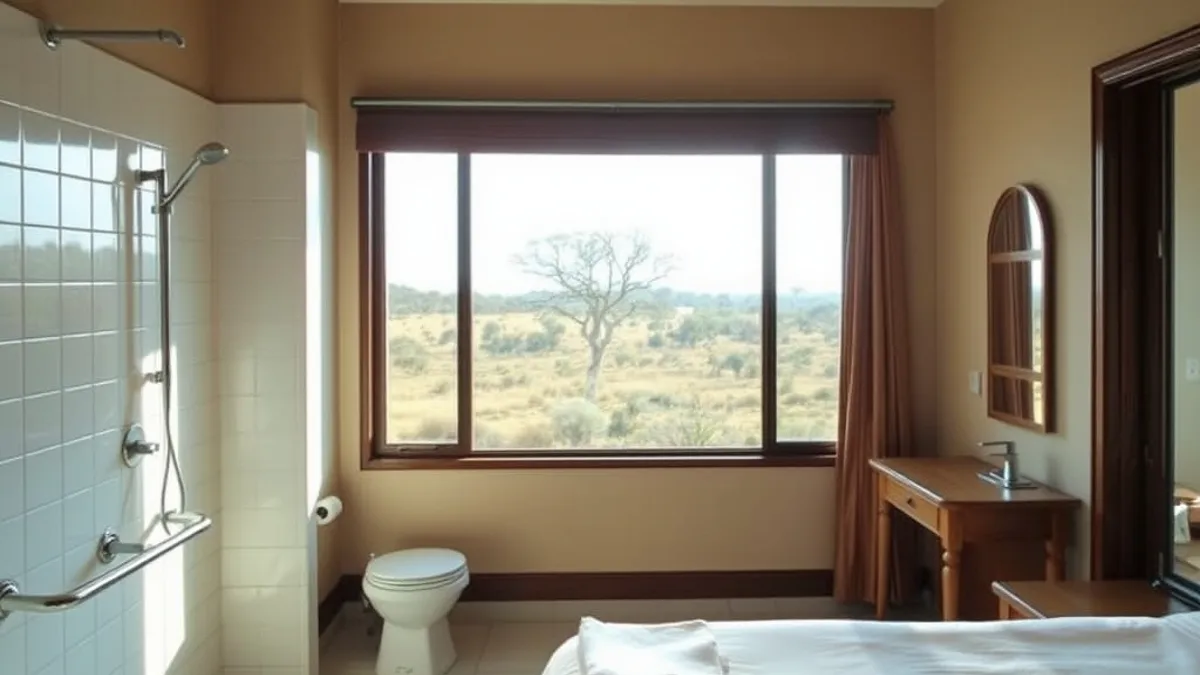
The bathroom deserves special attention. A roll-in shower with no threshold is the gold standard, since even a small lip can block a wheelchair or cause a stumble. Grab rails near the toilet and inside the shower add safety, and a shower chair should be available on request if it is not already installed.
Bed height is another detail people forget until it is too late. A bed that allows a safe transfer is typically 45-55 cm high, and there should be open space beside the bed rather than a wall, so you can position a wheelchair alongside it.
- Level access: in multi-level lodges, ask for a ground-floor room or confirm there is a lift, since some properties only have stairs to certain wings.
- Step-free routes: check that you can reach the dining area, lounge and pool without stairs, not just your room.
- Shower chair and extra equipment: confirm these can be placed in your room before arrival rather than fetched on demand.
Questions to Ask Before Booking an Accessible Lodge
Once you have shortlisted a lodge, the booking conversation is where you separate genuine accessibility from marketing language. A vague “yes, we are accessible” is not enough; you need specifics you can hold the lodge to. Approach this as a structured set of questions rather than a casual chat, and set aside time for a proper phone or email exchange rather than a quick message through a booking form. The lodges that respond well at this stage tend to deliver well on arrival, so treat the conversation itself as a test of what is to come.
- Ask for exact measurements. Request the doorway widths, the shower threshold height and the bed height in centimeters. Numbers let you compare against your own equipment and needs, while the word “accessible” lets you compare against nothing.
- Check the vehicles and the staff. Confirm whether game drive vehicles have lift or ramp access, and whether staff are trained to assist with transfers. A beautifully adapted room is of limited use if you cannot join the activities.
- See the actual room. Ask for photos of the accessible room itself or, better, a video call walkthrough. Website galleries often show standard rooms, so you may be looking at a room you will never sleep in.
- Get it in writing. Request an email confirming every promised feature. If something falls short on arrival, written confirmation gives you a clear basis to ask for a correction or remedy.
Lodges that answer these questions promptly and precisely are usually the ones that take accessibility seriously. Hesitation, vague replies or refusal to provide measurements are useful signals too, and often worth treating as your answer. If one lodge on your list falls short, move on to the next rather than settling for uncertainty, because a well-run lodge will rarely make you work this hard for basic information.
How to Book Lodge Accessibility the Right Way
Accessible lodge rooms are scarce, typically making up just 1-5% of a property’s inventory, and they sell out first. Plan to book 3-6 months ahead for a standard stay, and stretch that to 6-12 months if you want to travel during peak safari season between June and October. If you are flexible on dates, our guide to the best time to book a lodge stay in Kruger can help you time your reservation well.
Book directly, not through a filter
Once you have found a lodge that ticks your boxes, pick up the phone or send an email rather than relying on a website filter. Booking directly means your accessibility needs are attached to your actual reservation, not just a search preference that disappears the moment you confirm. Speak to a real person, spell out exactly what you need, and ask them to note it on your booking.
Then, confirm your requirements again 2-4 weeks before arrival. Lodges occasionally reassign rooms or take features out of service for maintenance, and a short follow-up call or email catches these problems while there is still time to fix them. A polite check-in a couple of weeks out is one of the simplest ways to protect your stay.
What Accessible Lodge Stays Typically Cost
Here is some good news: an accessible room usually costs the same as a standard room in the same category. Lodges typically do not charge a premium for a roll-in shower or wider doorways on their own. The catch is inventory, because with so few accessible rooms available, the right room may be sold out in the category you budgeted for, pushing you into a higher-priced room type instead.
Where the extra costs hide
Transfers are the most common surprise. If the lodge shuttle or airport transfer vehicle is not wheelchair accessible, you will need to arrange a private adapted transfer, and that can add a meaningful share of your total stay cost. Ask about transfer vehicles at the same time you book the room, so the full picture is clear before you commit.
Fully adapted safari lodges, the kind with specialized equipment, trained staff and genuinely step-free design throughout, tend to sit at the premium end of lodge pricing. That reflects the real investment behind them. If you want to understand what your money actually covers at a safari property, from staff to vehicles to food, our breakdown of what safari lodge costs really include is a useful read before you compare quotes.
Common Lodge Accessibility Pitfalls and How to Avoid Them
Even careful travelers get caught out by a few recurring mistakes when booking accessible lodges. The frustrating part is that every one of them is avoidable with a couple of extra questions, and most of them stem from the same root cause: relying on secondhand information instead of speaking to the people who actually run the property. A booking confirmation email feels like the finish line, but for accessible travel it is really just the starting point. Here are the pitfalls we see most often, and how to sidestep each one without turning your search into a full-time project.
- The lift that leads nowhere useful. A lodge can have a perfectly good lift and still have no adapted bathrooms on any floor. The two features are often unrelated, so ask specifically about grab rails, shower thresholds and turning space rather than assuming vertical access solves everything.
- Trusting booking site filters. Third-party platforms frequently mark rooms as accessible based on outdated or incomplete data supplied years ago. Treat the filter as a starting point for your search, then verify every detail directly with the lodge before paying.
- Ignoring the ground under your wheels. The route from your room to the dining area matters as much as the room itself, and in bush lodges it can be gravel, deep sand or a stepped path. Ask the lodge to describe the actual surface and gradient, and whether staff can assist if it is not step-free.
The common thread is simple: never accept a label or a single feature as proof of accessibility. A glossy website can show a beautifully adapted bathroom while omitting the twelve steps between the car park and reception, and no filter on any booking platform will flag that gap. Only a direct conversation with the lodge will surface it. Ask about the full journey, from the parking spot to your dinner table, and get the answers in writing so there is no ambiguity later. If a lodge is hesitant to put its accessibility claims in an email, that hesitation is useful information in itself. Ten minutes of specific questions before booking saves you from arriving to discover the lodge only half works for you, which is a far more expensive problem to fix on site than it is to prevent at home.
Wrapping Up Your Accessible Lodge Search
Finding a lodge that genuinely works for limited mobility comes down to one thing: verified details, not labels. Doorway widths of at least 80 cm, roll-in showers with no threshold and step-free routes are what make a stay comfortable, and because accessible rooms make up only 1-5% of inventory, booking early and directly with written confirmation is what turns a promising listing into a real reservation.
Ask specific questions, get promises in an email, and confirm everything again before you travel. That extra effort is the difference between arriving to an unusable room and settling straight into your trip. If this guide helped you plan, leave a comment or share it with a fellow traveler.